Understanding the changes and what our members are telling us
Significant changes to New Zealand’s environmental and planning framework are now underway, with the Government progressing legislation to replace the Resource Management Act (RMA). For catchment groups, these reforms raise important questions about community participation, freshwater management, and how local knowledge will be recognised in future decision-making.
To better understand both the policy direction and how these changes are being experienced on the ground, Catchment Communities Aotearoa (CCA) has been closely reviewing the proposed reforms and listening to feedback from our members across the country.
This article outlines what is changing, why it matters for catchment groups, and what we are hearing from the people doing this work in communities every day.
Related local government reform
Alongside RMA reform, the Government has also proposed significant changes to the local government system. While separate to the RMA replacement legislation, these reforms are closely linked and may influence how environmental functions, freshwater management, and community engagement are delivered at a regional level. For catchment groups, this raises questions about continuity of relationships, funding pathways, and how locally led catchment work is supported through any transition. CCA is monitoring both reform processes in parallel to understand their combined implications for catchment communities.
Member survey recap
What changes are being proposed?
The Government has announced two major bills to replace the Resource Management Act 1991:
The Natural Environment Bill
This bill focuses on managing the impacts of natural resource use and environmental protection. It introduces environmental limits for air, freshwater, land, soil, and biodiversity, with the aim of creating clearer national direction.
The Planning Bill
This bill focuses on enabling development and regulating land use, with a strong emphasis on housing, infrastructure, and productive activity.
Both bills passed their first reading in December 2025 and are currently before the Environment Select Committee, with submissions closing on 13 February 2026.
Alongside this, earlier amendments to freshwater management have already removed or paused several key requirements, including intensive winter grazing regulations, Significant Natural Areas identification, and Te Mana o te Wai compliance, without a clear replacement framework in place.
Why does this matter for catchment groups?
Catchment groups operate at the intersection of land, water, and community. Many of the proposed changes have direct implications for how catchment groups participate in environmental decision-making and how their work is recognised.
Community participation
Under the proposed reforms, community engagement is expected to shift earlier into combined regional plan development, with more limited opportunities for involvement at the consenting stage. Public notification thresholds are higher, and only those deemed “materially affected” may be able to participate. Catchment groups are unlikely to meet this threshold unless they are formally recognised at a regional level.
A shift from local to national direction
The reforms introduce nationally standardised provisions, with reduced scope for local variation unless it can be clearly justified. While this may simplify planning processes, it also risks sidelining locally developed catchment action plans and place-based knowledge.
Freshwater management uncertainty
With changes already underway and further reforms pending, there is uncertainty around how freshwater outcomes will be managed, monitored, and funded in the future, and how existing catchment initiatives will align with new frameworks.
Are there any potential benefits?
While there are real concerns, some aspects of the proposed reforms may offer opportunities if implemented well:
Environmental limits and management units could align more closely with catchment-based approaches.
Simplified planning processes may reduce duplication across councils.
Long-term spatial planning horizons align with the timeframes many catchment groups already work within.
If early plan development is well canvassed and inclusive, streamlined processes may follow.
Realising these benefits will depend heavily on how catchment groups are recognised and engaged within the new system.
What we heard from our members
To understand how these proposed changes are being experienced on the ground, CCA invited catchment groups across the country to share their perspectives through a short survey in late December.
The survey closed on 15 January 2026 and received a 45% response rate , from a wide range of regions and roles. Many respondents were committee members or coordinators actively involved in catchment governance and delivery.
Overall awareness of the proposed changes was relatively high. However, many respondents said they did not yet have a clear understanding of how the reforms would be implemented in practice. This highlighted a strong need for clearer, more accessible information during this transition period.
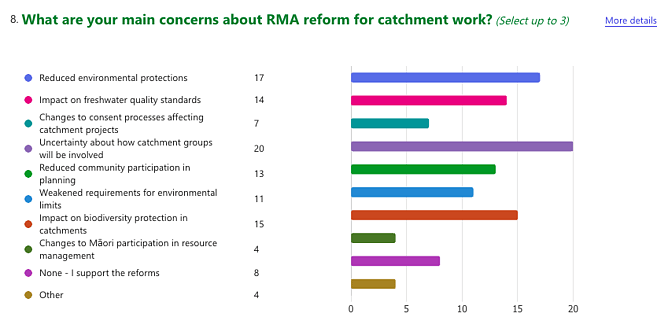
Key concerns raised included:
Uncertainty around ongoing funding for catchment projects
Potential loss of regional council knowledge and established relationships
Impacts on environmental decision-making and freshwater outcomes
Reduced opportunities for meaningful community participation
When asked specifically about RMA reform, uncertainty again stood out. Many respondents were unsure whether the changes would make it easier or harder to achieve their catchment goals.
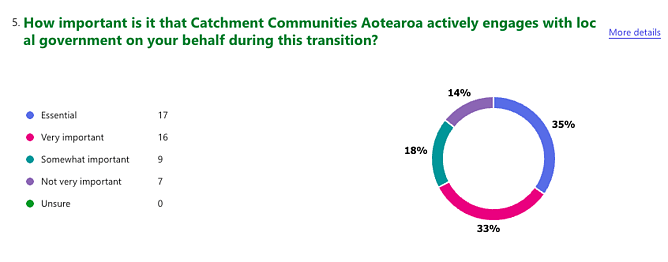
Importantly, members expressed strong support for CCA to play an active role during this period of change. The majority felt it was essential or very important that CCA engages constructively with both local and central government on their behalf.
“Members strongly support Catchment Communities Aotearoa playing an active, constructive role in engaging with government during this period of change.”
Respondents emphasised the value of timely information, direct advocacy, and practical support, and many indicated they are willing to stay involved in future discussions as reforms progress.
What happens next?
The insights shared through this survey will directly inform CCA’s advocacy and engagement work as Parliament returns and policy development continues. Our focus will be on ensuring that catchment groups are recognised as critical partners in environmental management, and that community-led, collaborative approaches remain central to achieving good outcomes for land and water.
We will continue to keep members informed as the legislative process unfolds and provide opportunities for input where possible.